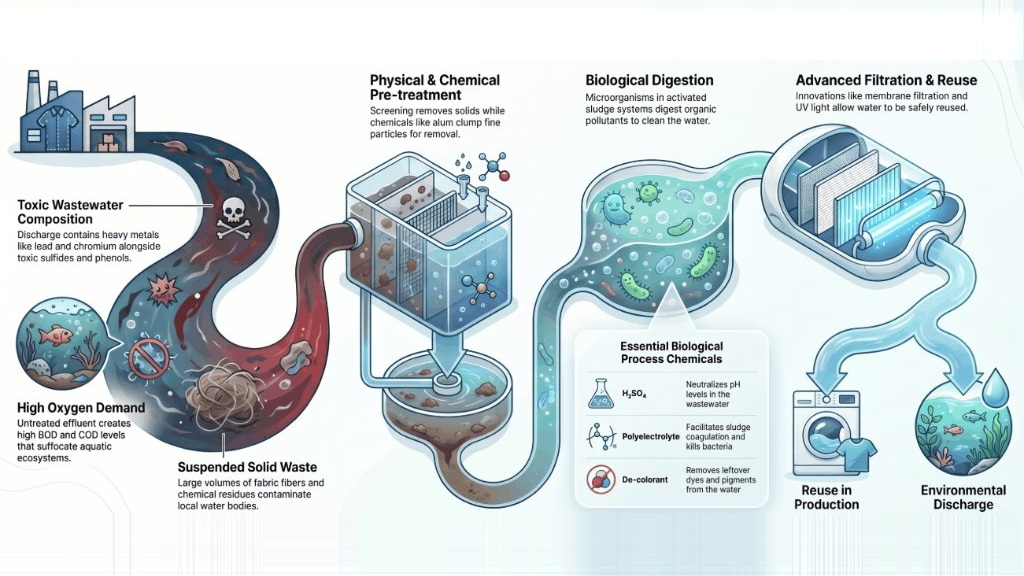
Textile manufacturing involves several water-intensive processes, including dyeing, bleaching, washing and fabric finishing. These operations generate wastewater containing dyes, chemicals, salts, suspended solids and organic pollutants. Managing this wastewater efficiently is essential for maintaining production quality, controlling operating costs and meeting environmental requirements.
However, even a properly installed Effluent Treatment Plant can experience operational difficulties. Sudden changes in wastewater composition, incorrect chemical dosing, equipment issues and poor maintenance can affect treatment efficiency. Advanced solutions such as Zero liquid discharge Effluent Treatment Plant systems can help textile manufacturers improve water recovery, minimise liquid waste discharge and support sustainable wastewater management.
Understanding common textile Effluent Treatment Plant problems helps manufacturers identify potential causes, improve treatment performance and avoid unnecessary expenses.
This article explores seven frequent Effluent Treatment Plant challenges faced by textile industries and practical ways to address them.
1
High COD and BOD Levels in Treated Wastewater
One of the most common challenges in textile effluent treatment is the presence of high Chemical Oxygen Demand (COD) and Biochemical Oxygen Demand (BOD).
These parameters indicate the amount of chemically oxidisable material and biodegradable organic matter present in wastewater.
Common causes
- ›Excessive organic pollutants from dyeing and washing operations
- ›Inadequate biological treatment
- ›Sudden increases in wastewater concentration
- ›Poor aeration in biological treatment tanks
- ›Unbalanced nutrient availability or unsuitable pH
Practical solutions
Start by testing influent and treated wastewater to understand where treatment performance is declining.
Check the biological treatment system's aeration, dissolved oxygen, pH and operating conditions. If the organic load regularly exceeds the plant's treatment capacity, process modifications may be necessary.
Regular monitoring is essential for achieving stable results.
Properly designed Effluent Treatment Plant Technology for Textile Industry applications can help manage changing organic loads through suitable equalisation, chemical treatment and biological processes.
2
Poor Colour Removal From Textile Wastewater
Textile dyeing processes generate strongly coloured effluent that may contain reactive, disperse, acid or other types of dyes.
Some dye compounds are difficult to remove using conventional biological treatment alone.
Common causes
- ›Incorrect coagulant selection
- ›Inadequate chemical dosing
- ›Poor mixing and flocculation
- ›Changes in dye composition
- ›Insufficient treatment time
Practical solutions
Conduct jar tests to identify appropriate coagulants, dosing levels and operating pH.
Evaluate whether the existing chemical treatment process can handle the dyes used in production.
For difficult-to-treat colour compounds, additional processes such as activated carbon adsorption or advanced oxidation may be considered after technical assessment.
The goal is to select a treatment method suitable for the actual wastewater characteristics rather than increasing chemical dosage without testing.
3
Excessive Sludge Generation in the Effluent Treatment Plant
Sludge management is another major concern for textile manufacturers.
Chemical treatment and biological processes naturally generate sludge. However, excessive production can increase dewatering, transportation and disposal expenses.
Common causes
- ›Overdosing coagulants and other treatment chemicals
- ›Inefficient solids separation
- ›Poor sludge settling
- ›Inappropriate polymer selection
- ›Inconsistent sludge dewatering
Practical solutions
Review chemical dosing to determine whether excessive chemicals are contributing to sludge generation.
Optimise coagulation and flocculation through laboratory testing.
Evaluate sludge thickening, conditioning and mechanical dewatering equipment to improve handling efficiency. Suitable sludge dewatering chemicals may improve solids separation and reduce the amount of water retained in the sludge.
Importantly, sludge must be characterised and managed according to applicable waste-handling and disposal requirements.
4
Unstable pH Levels During Treatment
Textile processing uses both acidic and alkaline chemicals. As a result, wastewater pH can change significantly throughout the production day.
These fluctuations may interfere with chemical treatment and the microorganisms responsible for biological treatment.
Common causes
- ›Discharge of concentrated acidic or alkaline wastewater
- ›Inadequate equalisation
- ›Incorrect dosing pump settings
- ›Poorly calibrated pH sensors
- ›Insufficient mixing
Practical solutions
Install or maintain an appropriately sized equalisation system to reduce sudden changes in wastewater characteristics.
Regularly calibrate pH sensors and inspect chemical dosing equipment.
Where feasible, segregate highly concentrated process streams before they enter the main Effluent Treatment Plant.
Automatic pH control can help maintain more consistent treatment conditions when correctly designed and maintained.
5
High TDS Levels in Textile Effluent
Textile dyeing and finishing processes often use salts and other dissolved substances. This can result in high Total Dissolved Solids (TDS) concentrations in wastewater.
Conventional biological treatment and clarification generally do not remove dissolved salts effectively.
Common causes
- ›Salt-intensive dyeing operations
- ›Inadequate segregation of high-salinity streams
- ›Repeated water reuse without sufficient salt removal
- ›Limited desalination capacity
Practical solutions
First, measure TDS, conductivity and the composition of dissolved salts.
Reducing unnecessary salt consumption during production and separating highly saline wastewater streams may improve overall treatment efficiency.
Where water reuse requires lower salinity, suitable technologies such as Reverse Osmosis (RO) may be considered. For facilities with specific recovery and discharge requirements, Zero Liquid Discharge systems may also be evaluated.
Technology selection must consider membrane scaling, concentrate management, energy requirements and operating costs.
6
Poor Sludge Settling and Foaming in Biological Tanks
Biological treatment systems require stable operating conditions.
When these conditions are disturbed, operators may notice poor settling, excessive foam or suspended solids escaping into treated water.
Common causes
- ›Sudden changes in wastewater loading
- ›Inadequate dissolved oxygen
- ›Nutrient imbalance
- ›Filamentous microbial growth
- ›Toxic compounds affecting biological activity
- ›Incorrect sludge retention or recycling rates
Practical solutions
Monitor dissolved oxygen, mixed liquor characteristics, sludge settling and organic loading.
Examine whether the problem is related to aeration, nutrient availability or changes in industrial effluent composition.
Review sludge recycling and wasting practices according to the treatment process. Avoid adding chemicals simply to suppress foaming without identifying the underlying cause.
Persistent biological treatment problems should be evaluated by an experienced wastewater treatment specialist.
7
Increasing Electricity and Chemical Operating Costs
A textile Effluent Treatment Plant may continue meeting treatment requirements while consuming more electricity and chemicals than necessary.
Over time, these additional expenses can significantly affect the operating budget.
Common causes
- ›Inefficient aeration systems
- ›Excessive chemical dosing
- ›Poorly maintained pumps and motors
- ›Blocked pipelines or filters
- ›Equipment operating continuously without demand-based control
- ›Inadequate process monitoring
Practical solutions
Conduct a detailed review of electricity consumption, chemical usage and treatment performance.
Evaluate whether blowers, pumps and dosing systems are operating efficiently.
Preventive maintenance can help identify equipment problems before they lead to serious failures. Automation and monitoring systems may also improve operational control by adjusting selected processes according to actual treatment requirements.
Before investing in major equipment upgrades, compare the expected savings with installation, maintenance and lifecycle costs.
How Can Textile Manufacturers Prevent Effluent Treatment Plant Problems?
Preventing treatment problems is generally more manageable than responding to unexpected system failures.
Textile manufacturers should establish a structured maintenance and monitoring programme.
Essential Effluent Treatment Plant maintenance practices
✓Monitor influent and treated wastewater quality.
✓Check pH and dissolved oxygen regularly.
✓Inspect dosing pumps, blowers and motors.
✓Maintain chemical storage and dosing equipment safely.
✓Monitor sludge production and settling behaviour.
✓Record electricity and chemical consumption.
✓Calibrate instruments according to manufacturer instructions.
✓Investigate unusual treatment results promptly.
Keeping accurate operating records helps identify recurring problems and supports better maintenance decisions.
For textile industries handling highly variable wastewater, regular technical evaluations are particularly valuable.
When Should a Textile Factory Upgrade Its Existing Effluent Treatment Plant?
Not every Effluent Treatment Plant problem requires a complete replacement.
Sometimes, performance improvements can be achieved by adjusting chemical dosing, upgrading aeration equipment, improving equalisation or modifying individual treatment stages.
However, a more substantial upgrade may be necessary when:
›Wastewater generation exceeds the original plant capacity.
›Existing treatment methods cannot manage changing pollutants.
›Treated effluent repeatedly fails to meet applicable limits.
›Operating and maintenance costs continue increasing.
›Water reuse requirements exceed the existing system's capabilities.
A professional assessment can help determine whether process optimisation, equipment modification or a new treatment configuration is the most appropriate solution.
Frequently Asked Questions
1. Why does COD remain high after Effluent Treatment Plant treatment? +
High COD may result from excessive organic loading, poor biological treatment, insufficient aeration or contaminants that are difficult to biodegrade. Wastewater testing and process evaluation can help identify the cause.
2. How can textile industries reduce Effluent Treatment Plant chemical consumption? +
Chemical consumption can often be optimised through jar testing, accurate dosing, proper pH control and regular equipment calibration.
3. Why does sludge generation increase in textile Effluent Treatment Plants? +
Excessive coagulant dosing, changing wastewater characteristics and inefficient treatment processes may contribute to increased sludge production.
4. Can an existing textile Effluent Treatment Plant be upgraded? +
Yes. Depending on the plant's condition and treatment requirements, upgrades may include improved aeration, chemical dosing, filtration, biological treatment or additional water recovery systems.
5. How often should a textile Effluent Treatment Plant be inspected? +
Operators should perform routine checks according to the plant's operating procedures. The frequency of laboratory testing, equipment servicing and professional inspections should reflect wastewater variability, manufacturer guidance and applicable regulatory requirements.
Conclusion
Efficient textile wastewater treatment requires more than installing an Effluent Treatment Plant. Continuous monitoring, appropriate chemical dosing, preventive maintenance and timely process improvements are essential for consistent performance.
Common problems such as high COD, poor colour removal, excessive sludge, unstable pH and increasing operating costs can often be addressed through systematic investigation and suitable treatment improvements.
At Senkar Water Tech, we provide industrial wastewater treatment solutions designed to support textile manufacturers in managing complex effluent streams, improving treatment reliability and optimising operational efficiency.
Whether your facility requires an Effluent Treatment Plant performance assessment, process improvement or a customised treatment solution, our team can help identify an appropriate approach.
Explore our Effluent Treatment Plant Technology for Textile Industryor contact Senkar Water Tech to discuss your wastewater treatment requirements.